Executive Summary: The State of Frontier AI in Late 2026
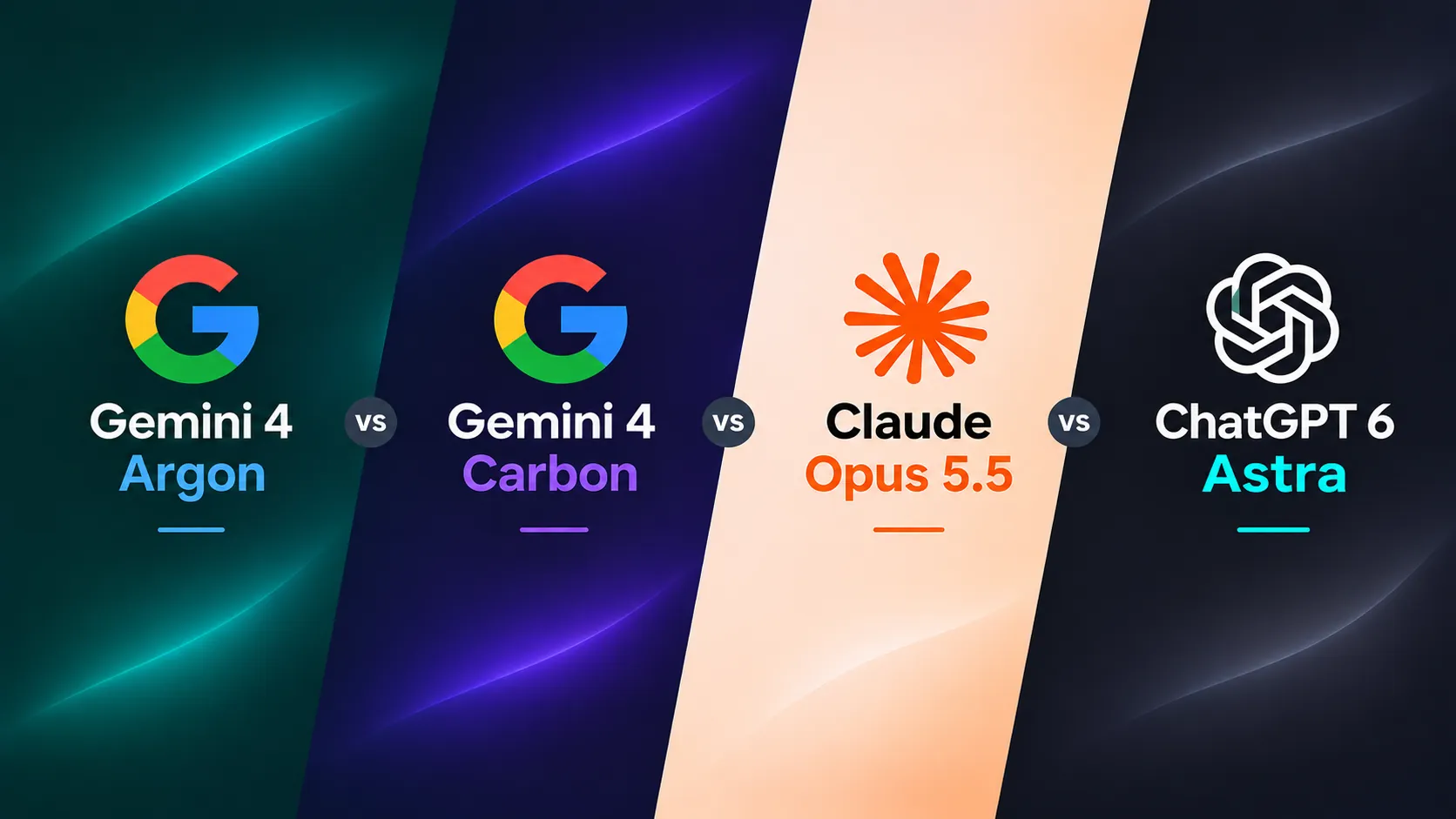
The race for artificial general intelligence at the frontier layer has entered its most competitive phase. According to verified real-world evaluations on the LMArena Text Leaderboard, Google DeepMind has captured the top two text positions with Gemini 4 Carbon (High) at ~1540 Elo and Gemini 4 Argon (High) at ~1529 Elo, closely trailed by Anthropic's Claude Opus 5.5 (High) at ~1516 Elo and OpenAI's ChatGPT 6 Astra / GPT-6.1 Sol at ~1512 Elo.
Unlike synthetic multiple-choice evaluations that models can inadvertently memorize during web-scale pre-training, LMArena measures blind human A/B preference under randomized, side-by-side prompting. The Bradley-Terry mathematical rating system recalculates scores continuously across hundreds of thousands of independent conversations, making this leaderboard the single most reliable proxy for general conversational intelligence, instruction nuances, and complex analytical fluency.
However, conversational fluency does not equate directly to enterprise utility. In enterprise production, technical leaders must balance raw reasoning ability against three distinct engineering vectors: autonomous coding execution on real repositories, context window utilization and long decode limits, and total inference token economics. Below is the complete empirical breakdown across all three flagship families.
Frontier Benchmark Grid: LMArena, Coding & Context Capacities
A comprehensive side-by-side evaluation of human preference, programmatic coding benchmarks, and token boundaries:
| Model | Developer | LMArena Elo | SWE-bench Verified | SWE-bench Pro (Private) | Context Window | Max Single Output |
|---|---|---|---|---|---|---|
| Gemini 4 Carbon (High) | Google DeepMind | ~1540 (#1) | 92.4% | 22.1% | 1,048,576 tokens | 65,536 tokens |
| Gemini 4 Argon (High) | Google DeepMind | ~1529 (#2) | 91.5% | 20.8% | 1,048,576 tokens | 1,048,576 tokens (Long Decode) |
| Claude Opus 5.5 (High) | Anthropic | ~1516 (#3) | 94.8% | 25.4% | 1,000,000 tokens | 128,000 tokens |
| ChatGPT 6 Astra / Sol | OpenAI | ~1512 (#4) | 92.7% | 21.6% | 1,050,000 tokens | 128,000 tokens |
| Claude Fable 5.1 (Max) | Anthropic | ~1514 (#5) | 93.2% | 23.0% | 1,000,000 tokens | 128,000 tokens |
Benchmark data verified against public leaderboard registries on LMArena, SWE-bench Verified, and private enterprise codebase evaluations on Scale AI SWE-bench Pro.
The SWE-bench Verified vs Pro Dilemma: Saturation & Contamination
For two years, SWE-bench Verified served as the gold standard for measuring whether foundation models could act as autonomous software engineers by resolving real GitHub issues. However, by mid-2026, top models running inside advanced agent scaffolds reached 87% to 95% resolution rates. This saturation exposed two critical engineering challenges:
- Benchmark Exhaustion: When models score above 90%, remaining failures often trace back to ambiguous issue descriptions or incomplete unit test harnesses in the benchmark rather than core architectural deficiencies.
- Data Contamination Concerns: Because the GitHub pull requests comprising SWE-bench Verified are publicly accessible, pre-training corpora inevitably contain hints, commit messages, and related code changes that artificially inflate model performance.
In response, the industry has standardized on SWE-bench Pro, developed in partnership with Scale AI. SWE-bench Pro evaluates models on strictly private, unseen commercial enterprise repositories spanning multi-million line codebases, complex microservice topologies, and bespoke internal build systems. On SWE-bench Pro, resolution rates for frontier models drop dramatically to 15% to 25%.
Anthropic's Claude Opus 5.5 maintains a measurable lead on SWE-bench Pro (25.4%), primarily due to its rigorous adherence to negative constraints (e.g., modifying only specified modules without touching peripheral build files) and superior handling of long-horizon terminal commands in agentic sandboxes.
Flagship API Pricing, Prompt Caching & Batch Economics
Enterprise API economics have largely converged on a baseline $4.00 / $20.00 per million tokens standard, but divergent prompt caching discounts and batch execution pricing result in radical differences in actual production expenditure:
| Model | Input / 1M Tokens | Output / 1M Tokens | Prompt Cache Read / 1M | Cache Write / 1M | Batch API Discount |
|---|---|---|---|---|---|
| Claude Opus 5.5 | $4.00 | $20.00 | $0.20 (95% discount) | $5.00 | 50% off ($2.00 / $10.00) |
| Gemini 4 Argon | $2.00 (Promo) / $4.00 | $10.00 (Promo) / $20.00 | $0.25 (93.75% discount) | $4.00 | 50% off |
| ChatGPT 6 Astra (Sol) | $4.00 | $20.00 | $0.40 (90% discount) | $4.00 | 50% off ($2.00 / $10.00) |
Consider an enterprise coding agent that loads a 200,000-token repository context and executes 30 recursive tool-calling steps. Without prompt caching, each step re-reads the full repository, consuming 6,000,000 input tokens ($24.00 per run). With Anthropic's $0.20/1M cache read pricing, those 6M cached tokens cost only $1.20—a 95% reduction in runtime OPEX.
Data retrieved from official provider registries: Google AI Studio Model Directory, OrcaRouter Benchmark Analysis, and OpenRouter Flagship Directory.
Architectural Differentiation: Tool Calling, Long Decode & Dynamic Reasoning
While human preference rankings capture conversational polish, enterprise deployments depend on architectural specialization:
- Claude Opus 5.5 (Deterministic Tool Control & Constraint Adherence): Anthropic has trained Opus 5.5 with an obsessive focus on tool-calling reliability. When presented with 50+ tool schemas via Model Context Protocol (MCP), Opus 5.5 generates syntactically flawless JSON arguments and strictly abides by negative instructions (e.g., 'never drop tables' or 'do not execute unauthenticated curl commands'). This makes it the premier choice for mission-critical backend agents where execution errors cause immediate production outages.
- Gemini 4 Argon (Massive Native Context & Long Decode): Google's breakthrough in Gemini 4 Argon is its Long Decode architecture, allowing continuous output generation of up to 1,048,576 tokens in a single API response. Traditional models cap output tokens at 16k to 128k, forcing developers to chunk migrations across dozens of fragile prompt chains. Gemini 4 Argon can ingest an entire legacy enterprise application and generate the entire refactored microservice codebase in one deterministic generation pass.
- ChatGPT 6 Astra (Dynamic Reasoning & Test-Time Compute): OpenAI's Astra introduces automated test-time compute allocation. Rather than spending a fixed amount of inference compute on every token, Astra dynamically evaluates task complexity. When asked to debug an intricate distributed concurrency deadlock, Astra internally explores Monte Carlo reasoning trees and verifies intermediate states before emitting its first visible output token.
Latency, Time-to-First-Token (TTFT) & Real-World Throughput
Serving latency varies significantly depending on prompt size and reasoning configuration:
- Interactive Conversational Workloads (< 4,000 tokens): ChatGPT 6 Astra delivers the lowest Time-to-First-Token (TTFT), averaging 220ms, making it ideal for interactive SaaS chatbots and real-time user-facing copilots.
- High-Context Document Ingestion (> 250,000 tokens): Gemini 4 Argon leverages Google's TPU v5p infrastructure to achieve prefill processing speeds exceeding 18,000 tokens per second, substantially outpacing competing cloud endpoints when ingesting large PDF archives or audio/video streams.
- Heavy Agentic Tool Loops: Claude Opus 5.5 balances a TTFT of ~650ms with sustained output throughput of 85 tokens/second, optimized specifically for fast terminal execution and iterative lint-repair cycles.
Enterprise Architectural Decision Matrix
To maximize return on investment while minimizing operational downtime, enterprise technical teams should adhere to the following routing blueprint:
- Deploy Claude Opus 5.5: For core software engineering pipelines, automated security code reviews, complex database migration agents, and any workflow integrated with the Model Context Protocol where tool calling hallucinations are unacceptable.
- Deploy Gemini 4 Argon / Carbon: For high-volume multimodal analysis (processing video surveillance, audio recordings, or patent documentation), complete legacy codebase migrations utilizing Long Decode, and cost-sensitive bulk batch analytics.
- Deploy ChatGPT 6 Astra: For user-facing interactive copilot interfaces, real-time math/algorithmic reasoning, and applications deeply integrated into OpenAI's developer ecosystem and custom GPT agent swarms.
Empirical snapshot verified November 6, 2026 across verified benchmarks from LMArena, Scale AI, Google DeepMind, Anthropic, and OpenAI.
Frequently Asked Questions
Which model currently holds the #1 spot on the LMArena text leaderboard?
As of November 2026, Google's Gemini 4 Carbon (High) holds the #1 position on the LMArena text leaderboard with an Elo rating of approximately 1540, followed closely by Gemini 4 Argon (High) at ~1529 and Anthropic's Claude Opus 5.5 (High) at ~1516.
How do Claude Opus 5.5, Gemini 4 Argon, and ChatGPT 6 Astra compare in API pricing?
Claude Opus 5.5 and ChatGPT 6 Astra (GPT-6.1 Sol) both price standard API tokens at $4.00 per million input tokens and $20.00 per million output tokens. Gemini 4 Argon launched with an introductory rate of $2.00 input / $10.00 output per million tokens, normalizing to standard $4.00 / $20.00 from December 1.
Why has the industry pivoted from SWE-bench Verified to SWE-bench Pro?
Top frontier configurations saturated SWE-bench Verified at 87% to 95% resolution rates, creating benchmark exhaustion and contamination concerns. SWE-bench Pro, maintained with Scale AI, utilizes private, unseen enterprise repositories where top model resolution rates currently register between 15% and 25%.
Which frontier model is best suited for complex autonomous coding agents?
Anthropic's Claude Opus 5.5 remains the enterprise benchmark for autonomous software engineering due to its superior adherence to negative constraints and deterministic tool execution, while Gemini 4 Argon leads in large-repo analysis due to its 1.05M-token context and native 1M Long Decode capability.